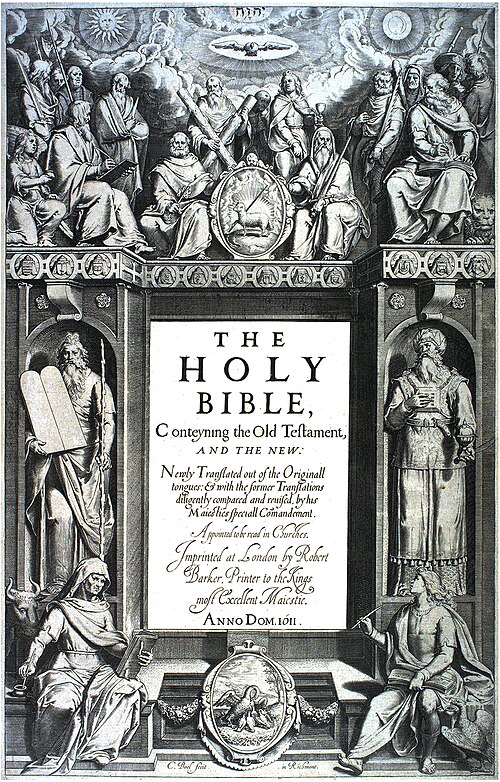
The frontispiece to the King James Bible, 1611, shows the Twelve Apostles at the top. Moses and Aaron flank the central text. In the four corners sit Matthew, Mark, Luke, and John, authors of the four gospels, with their symbolic animals. At the top, over the Holy Spirit in the form of a dove, is the Tetragrammaton “יהוה” (“YHWH”).
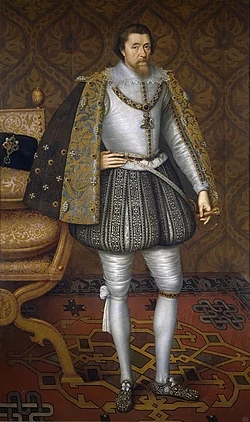
The King James Bible, widely known by the nickname King James Version (KJV) and the Authorized Version, is an Early Modern English translation of the Christian Bible for the Church of England and Church of Scotland, which was commissioned in 1604 and published in 1611, by sponsorship of King James VI and I. The 80 books of the KJV, the King James Bible, widely known by the nickname King James Version (KJV) and the Authorized Version, is an Early Modern English translation of the Christian Bible for the Church of England and Church of Scotland, which was commissioned in 1604 and published in 1611, by sponsorship of King James VI and I. The 80 books of the KJV include 39 books of the Old Testament, 14 books of Apocrypha, and the 27 books of the New Testament.
The King James Version was the third translation into English approved by the Church of England. The first was the Great Bible in 1535, and the second was the Bishops’ Bible in 1568. Meanwhile in Switzerland, the first generation of Protestant Reformers had produced the Geneva Bible in 1560, which proved more popular among the laity. However, the footnotes represented a Calvinistic Puritanism.
The KJV does not include a commentary on the text, as the King believed that it might contain anti-monarchist sentiment, as had its predecessor, the Geneva Bible.
There were several translations into Middle English of large portions of Scripture in the 14th Century, with the first English complete bibles probably being made by the followers of John Wycliffe. These translations were effectively but not formally banned in 1409 due to their association with the Lollards. The Wycliffite Bibles pre-dated the printing press but were circulated very widely in manuscript form.
In 1525, William Tyndale, an English contemporary of Martin Luther, undertook a translation of the New Testament into Early Modern English. Tyndale’s translation was the first printed Bible in English. Over the next ten years, Tyndale revised his New Testament in the light of rapidly advancing biblical scholarship, and embarked on a translation of the Old Testament. Despite some controversial translation choices, and in spite of Tyndale’s execution on charges of heresy for being a Lutheran, the merits of Tyndale’s work and prose style made his translation the ultimate basis for all subsequent renditions into Early Modern English
https://en.wikipedia.org/wiki/King_James_Version
*** ***
 <<<
<<<