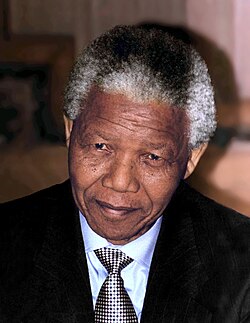
Nelson Rolihlahla Mandela (18 July 1918 – 5 December 2013) was a South African anti-apartheid revolutionary, politician, and philanthropist who served as President of South Africa from 1994 to 1999.
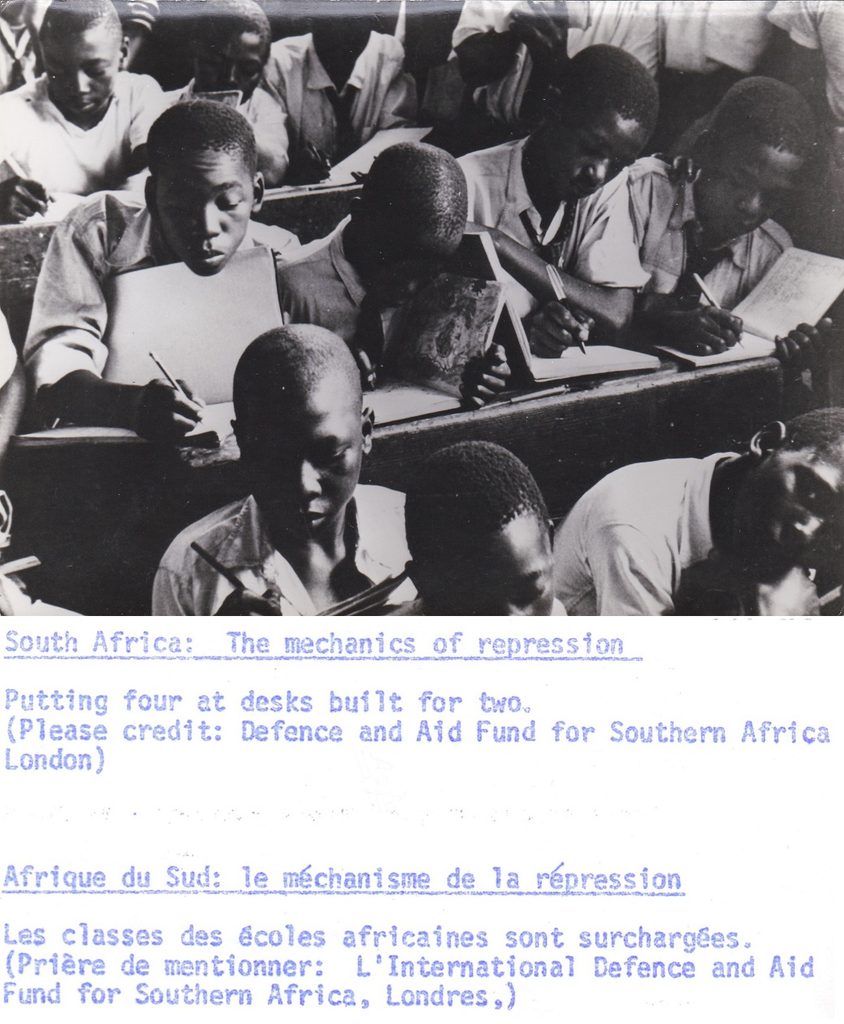
Apartheid, especially South African English transl. ”separateness”, was a system of institutionalized racial segregation that existed in South Africa and South West Africa (now Namibia) from 1948 to 1994. It was characterized by an authoritarian political culture based on boss-ship or boss-hood, which ensured that South Africa was dominated politically, socially, and economically by the nation’s minority white population. Under this minoritarian system, white citizens held the highest status, followed by Indians, Coloureds and black Africans, in that order. The economic legacy and social effects of apartheid continue to persist to the present day, particularly inequality.
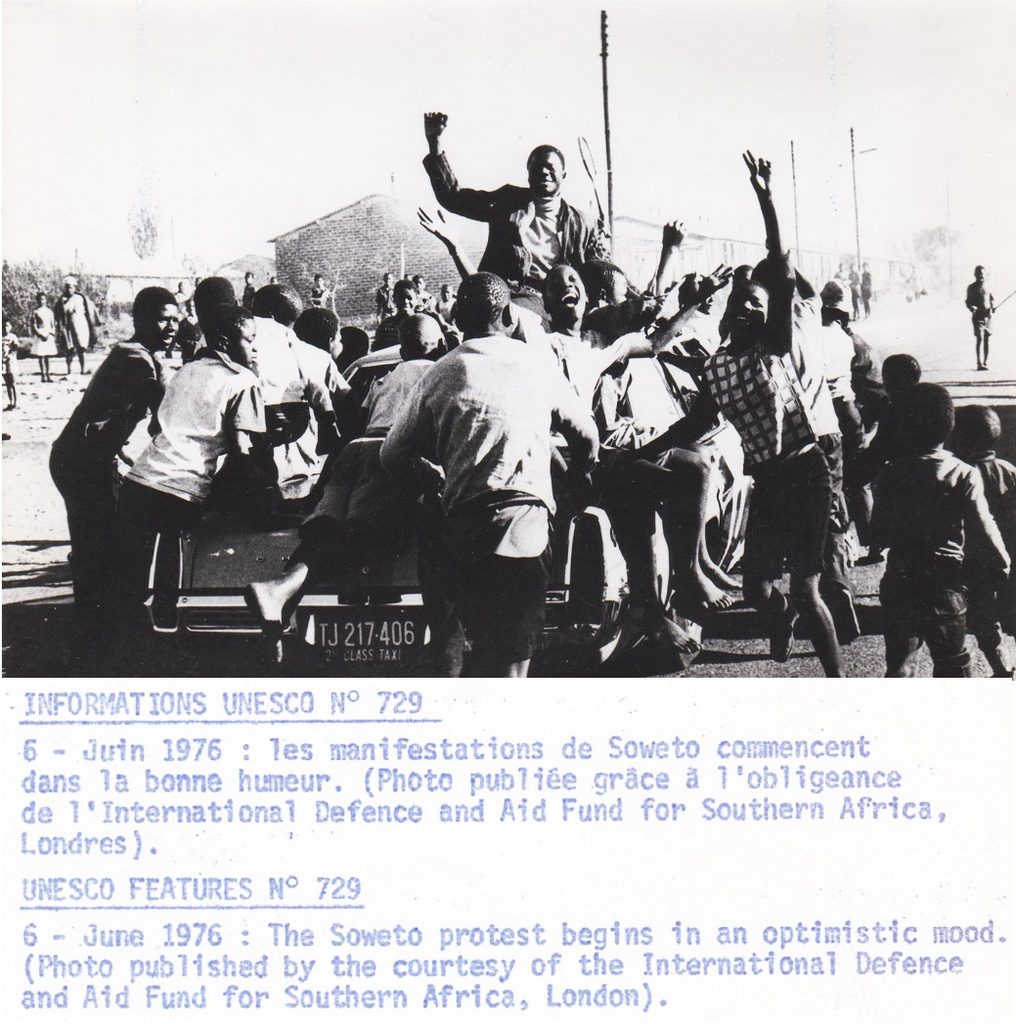
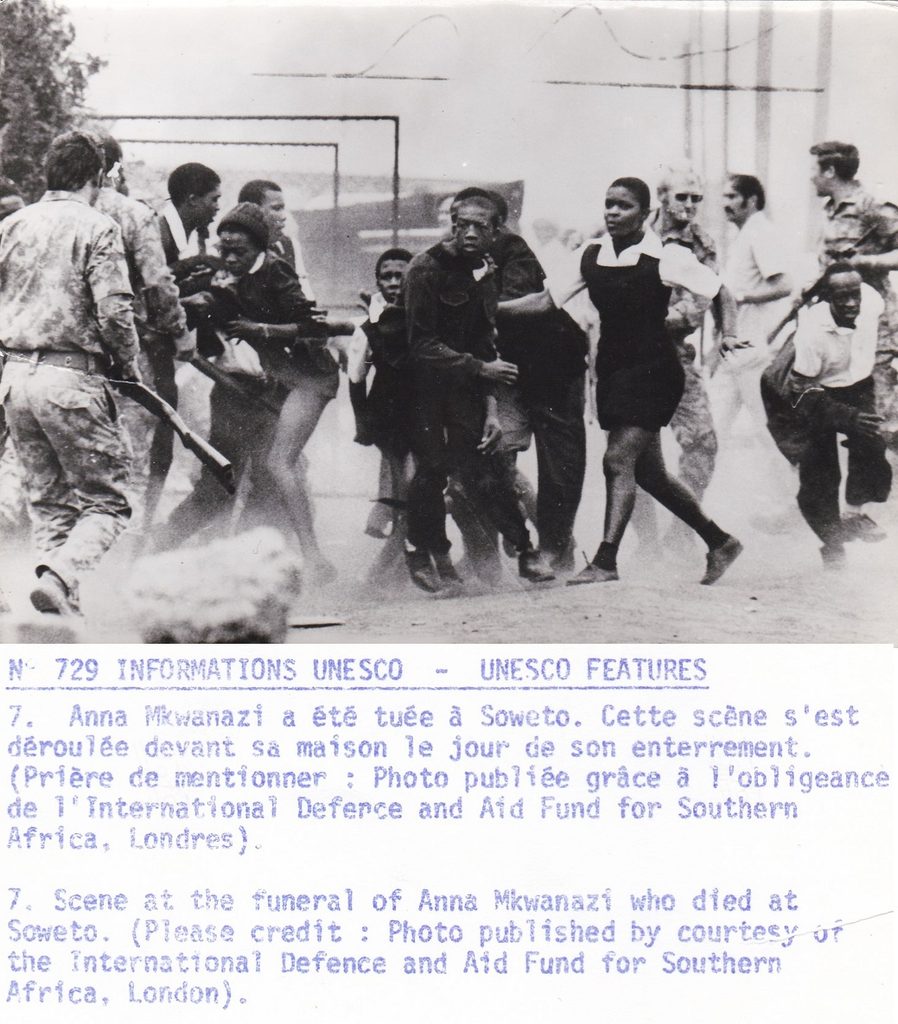
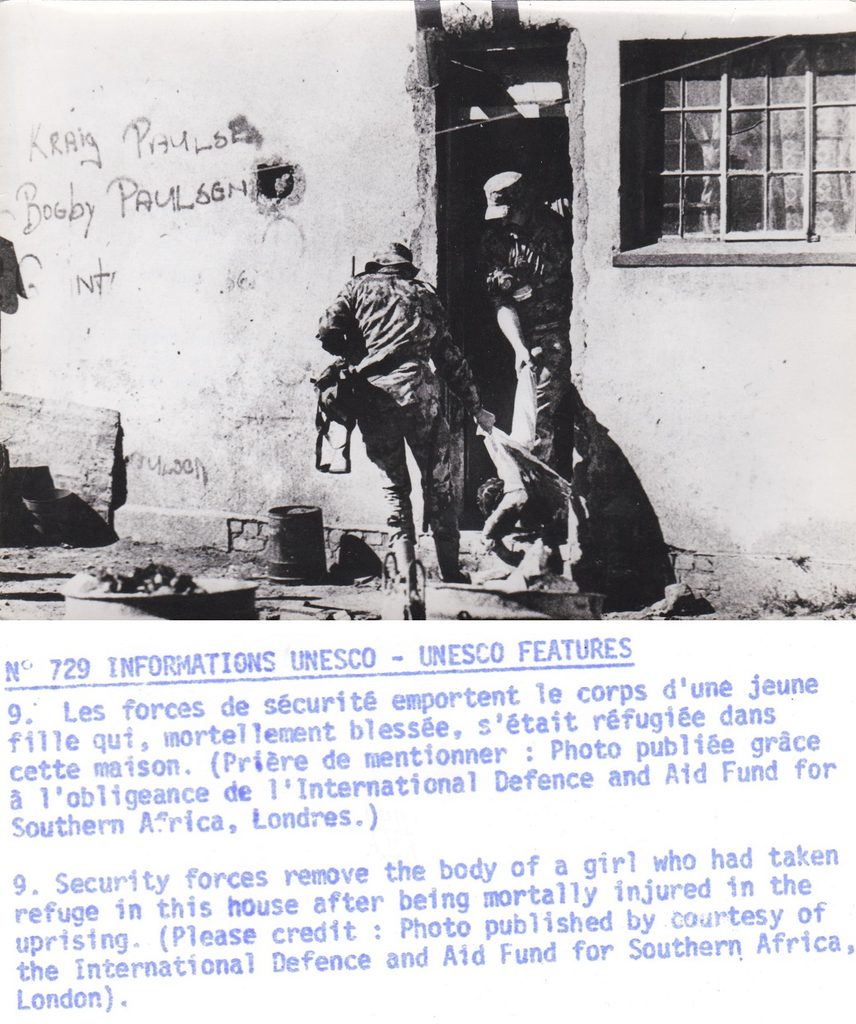
PHOTOS FROM EMMI MEDIATECH:
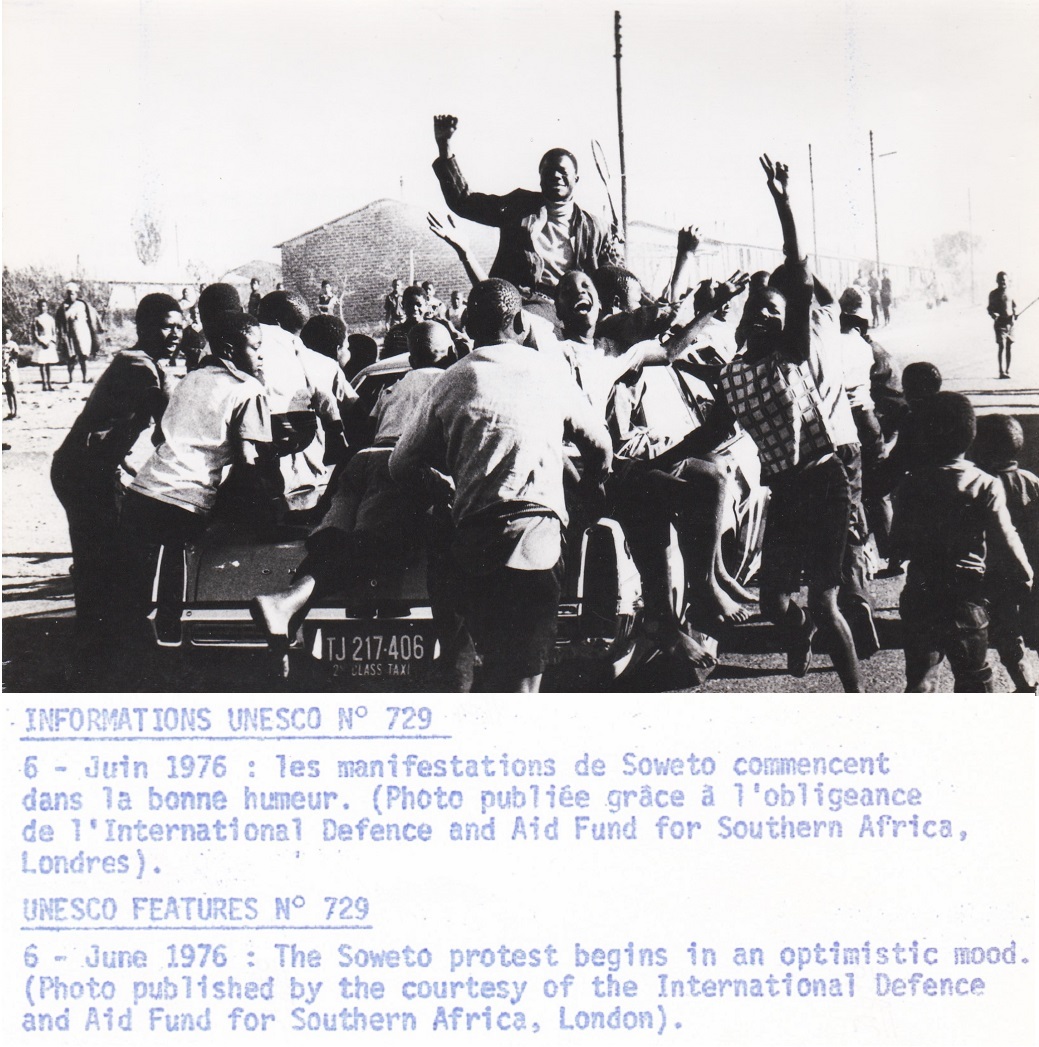
Apartheid 1976-1977
Click on image for bigger picture
unersco-729-june-6
Image 2 of 6
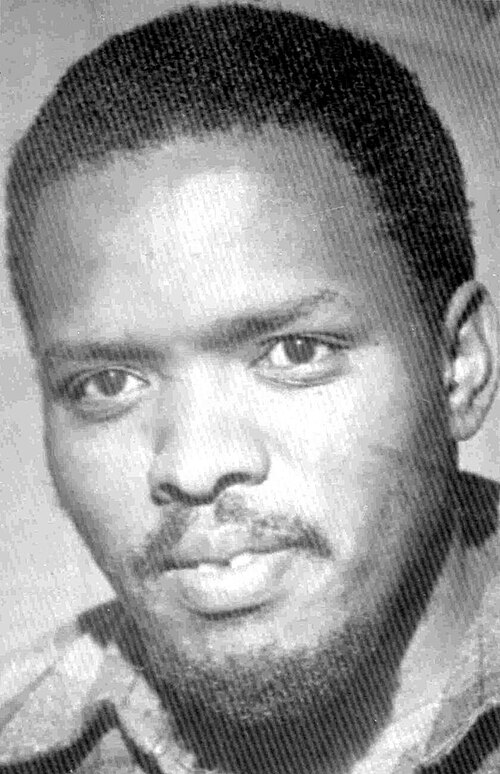
Flyer for the Steve Biko Memorial at the Carver Cultural Center, on February 10, 1978, featuring performances, speakers, and a film. There is a black-and-white photo of Biko with the details of the event underneath.
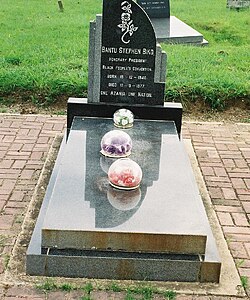
Bantu Stephen Biko OMSG (18 December 1946 – 12 September 1977) was a South African anti-apartheid activist. Ideologically an African nationalist and African socialist, he was at the forefront of a grassroots anti-apartheid campaign known as the Black Consciousness Movement during the late 1960s and 1970s. His ideas were articulated in a series of articles published under the pseudonym Frank Talk.
Raised in a poor Xhosa family, Biko grew up in the township of Ginsberg in the Eastern Cape. In 1966, he began studying medicine at the University of Natal, where he joined the National Union of South African Students (NUSAS). Strongly opposed to the apartheid system of racial segregation and white-minority rule in South Africa, Biko was frustrated that NUSAS and other anti-apartheid groups were dominated by white liberals, rather than by the blacks who were most affected by apartheid. He believed that well-intentioned white liberals failed to comprehend the black experience and often acted in a paternalistic manner. He developed the view that, to avoid white domination, black people had to organize independently, and, to this end, he became a leading figure in the creation of the South African Students’ Organization (SASO) in 1968. Membership was open only to “Blacks”, a term that Biko used in reference not just to Bantu-speaking Africans but also to Coloureds and Indians. He was careful to keep his movement independent of white liberals, but opposed anti-white hatred and had white friends. The white-minority National Party government were initially supportive, seeing SASO’s creation as a victory for apartheid’s ethos of racial separatism.
Influenced by the Martinican philosopher Frantz Fanon, Biko and his compatriots developed Black Consciousness as SASO’s official ideology. The movement campaigned for an end to apartheid and the transition of South Africa toward universal suffrage and a socialist economy. It organized Black Community Programmes (BCPs) and focused on the psychological empowerment of black people. Biko believed that black people needed to rid themselves of any sense of racial inferiority, an idea he expressed by popularizing the slogan “black is beautiful”. In 1972, he helped found the Black People’s Convention (BPC) to promote Black Consciousness among the wider population. The government came to see Biko as a subversive threat and placed him under a banning order in 1973, severely restricting his activities. He remained politically active, helping to organize BCPs, such as a healthcare centre and a crèche, in the Ginsberg area. During his ban, he received repeated anonymous threats and was detained by state security services on several occasions. Following his arrest in August 1977, Biko was beaten to death by state security officers. Over 20,000 people attended his funeral.
Biko’s fame spread posthumously. He became the subject of numerous songs and works of art, while a 1978 biography by his friend Donald Woods formed the basis for the 1987 film Cry Freedom. During Biko’s life, the government alleged that he hated whites, various anti-apartheid activists accused him of sexism, and African racial nationalists criticized his united front with Coloureds and Indians. Nonetheless, Biko became one of the earliest icons of the movement against apartheid, and is regarded as a political martyr and the “Father of Black Consciousness”. His political legacy remains a matter of contention.
Arrest and death In 1977, Biko broke his banning order by travelling to Cape Town, hoping to meet Unity Movement leader Neville Alexander and address growing dissent in the Western Cape branch of the BCM, which was dominated by Marxists such as Johnny Issel. Biko drove to the city with his friend Peter Jones on 17 August, but Alexander refused to meet with Biko, fearing that the police were monitoring him. Biko and Jones drove back toward King William’s Town, but on 18 August they were stopped at a police roadblock near Grahamstown. Biko was arrested for having violated the order restricting him to King William’s Town. Unsubstantiated claims have been made that the security services were aware of Biko’s trip to Cape Town and that the roadblock had been erected to catch him. Jones was also arrested at the roadblock and subsequently held without trial for 533 days, during which he was interrogated on numerous occasions.
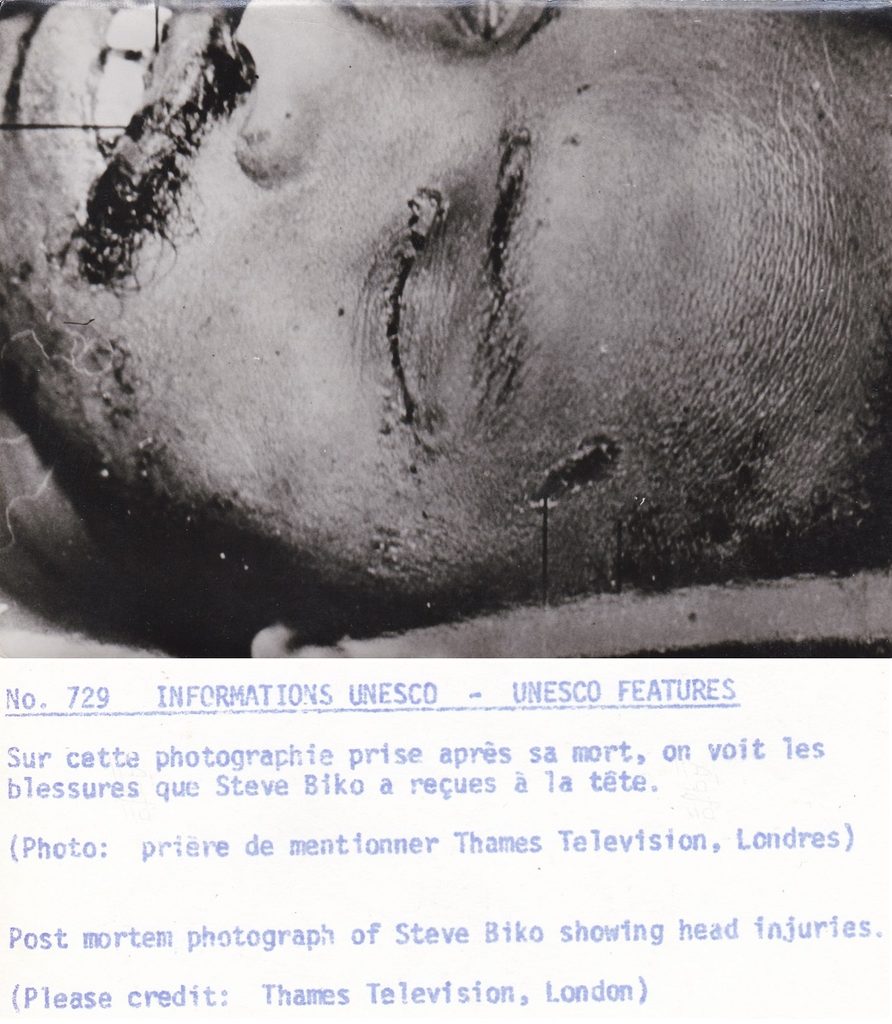
The security services took Biko to the Walmer police station in Port Elizabeth, where he was held naked in a cell with his legs in shackles. On 6 September, he was transferred from Walmer to room 619 of the security police headquarters in the Sanlam Building in central Port Elizabeth, where he was interrogated for 22 hours, handcuffed and in shackles, and chained to a grille. Exactly what happened has never been ascertained, but during the interrogation he was severely beaten by at least one of the ten security police officers. He suffered three brain lesions that resulted in a massive brain hemorrhage on 6 September. Following this incident, Biko’s captors forced him to remain standing and shackled to the wall. The police later said that Biko had attacked one of them with a chair, forcing them to subdue him and place him in handcuffs and leg irons.
Biko was examined by a doctor, Ivor Lang, who stated that there was no evidence of injury on Biko. Later scholarship has suggested Biko’s injuries must have been obvious. He was then examined by two other doctors who, after a test showed blood cells to have entered Biko’s spinal fluid, agreed that he should be transported to a prison hospital in Pretoria. On 11 September, police loaded him into the back of a Land Rover, naked and manacled, and drove him 740 miles (1,190 km) to the hospital. There, Biko died alone in a cell on 12 September 1977. According to an autopsy, an “extensive brain injury” had caused “centralisation of the blood circulation to such an extent that there had been intravasal blood coagulation, acute kidney failure, and uremia”. He was the twenty-first person to die in a South African prison in twelve months, and the forty-sixth political detainee to die during interrogation since the government introduced laws permitting imprisonment without trial in 1963.
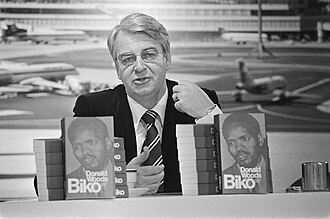
South African Donald Woods at Schiphol regarding the Dutch translation of his book about Steve Biko. Date: July 3, 1978.
Socrammm
Stephen Bantu Biko, dit Steve Biko, né le 18 décembre 1946 et mort le 12 septembre 1977, est un militant noir sud-africain et une des figures de la lutte anti-apartheid. Il meurt en détention en 1977 à l’âge de 30 ans, vraisemblablement tué par des policiers.
Le 12 septembre 1977, Biko meurt en détention, officiellement après s’être cogné la tête contre un mur, mais en réalité après avoir été torturé par la police. Le prêche lors de ses funérailles est assuré par Desmond Tutu, futur prix Nobel de la paix, alors proche de la Black theology (théologie noire).
Les conditions de détention, ainsi que le décès brutal de Biko, font l’objet d’une polémique internationale qui aboutit sur la condamnation du régime sud-africain. À l’ONU, le Conseil de sécurité vote, coup sur coup, les résolutions 417 (31 octobre 1977) et 418 (4 novembre 1977), cette dernière imposant un embargo sur les ventes d’armes à destination de l’Afrique du Sud. Après son décès, Biko devient le symbole de la résistance noire face à la cruauté du pouvoir en place .
Aux questions de la députée libérale Helen Suzman sur la mort de Biko, la réponse du ministre de la Justice, Jimmy Kruger, retentit à travers le monde entier : « La mort de Steve Biko me laisse froid. ». Les policiers concernés ne reçoivent qu’un blâme dans un premier temps, alors que les médecins impliqués sont pris à partie par leurs collègues, notamment par une enquête d’éthique médicale menée par Frances Ames, qui s’achèvera en 1985, année où la Cour suprême d’Afrique du Sud statue en faveur de sanctions contre les chirurgiens. La police finit par avouer le meurtre de Steve Biko à la Commission de vérité et réconciliation à la fin des années 1990.
Le 7 octobre 2003, soit près de dix ans après l’avènement d’un régime multiracial en Afrique du Sud, la justice sud-africaine renonce à poursuivre les cinq policiers pour manque de preuves et d’absence de témoins.
Le 12 septembre 2025, la justice sud-africaine rouvre l’enquête sur sa mort.
In United Nations Security Council Resolution 417, adopted on October 31, 1977, after reaffirming Resolution 392 (1976), the Council condemned the continuing repression against black people and other opponents of apartheid, as well as the South African media and the mounting deaths of detainees. The Council foresaw that the continuation of such activities would lead to serious racial conflict with international repercussions.
The resolution demanded therefore that the Government of South Africa:
(a) end the violence against the opponents of apartheid;
(b) release all persons held under arbitrary security laws;
(c) cease its violent response to demonstrations against apartheid;
(d) remove bans on news media opposed to apartheid;
(e) abolish the “Bantu education system” and the bantustans.
The resolution went on to ask Member States to support it and to provide assistance to those fleeing South Africa. It also requested the Secretary-General Kurt Waldheim, along with the Special Committee against Apartheid, to monitor the situation and issue a report on the implementation of Resolution 417 by February 17, 1978.
The meeting, called for by Tunisia in light of the repressive measures adopted by South Africa, unanimously adopted the resolution. Three previous draft resolutions were rejected due to objections by some permanent members of the Council.
La résolution 417 du Conseil de sécurité des Nations unies a été adoptée le 31 octobre 1977.
Après avoir rappelé la résolution 392, le Conseil condamne la répression continue contre les personnes noires, les opposants à l’apartheid et les médias sud-africains, ainsi que le nombre croissant de morts. Le Conseil prévoit que la poursuite de telles activités entraînera de graves conflits raciaux aux répercussions internationales.
La résolution exige:
La fin des violences contre les opposants à l’apartheid,
La libération des personnes détenues en vertu de lois arbitraires,
La fin de la réponse violente aux manifestations anti-apartheid,
La levée des interdictions envers les médias s’opposant à l’apartheid,
L’abolition du « système éducatif bantou » et des bantoustans.
La résolution demande ensuite aux États membres de la soutenir et de fournir une assistance à ceux qui fuient l’Afrique du Sud. Le conseil demande également au secrétaire général Kurt Waldheim, ainsi qu’au Comité spécial contre l’apartheid, de surveiller la situation et de publier un rapport sur la mise en œuvre de la résolution 417 d’ici le 17 février 1978.
La réunion du conseil, convoquée par la Tunisie à la lumière des mesures répressives prises par l’Afrique du Sud, adopte la résolution à l’unanimité. Trois projets de résolution précédents sont rejetés en raison des objections de certains membres permanents du conseil
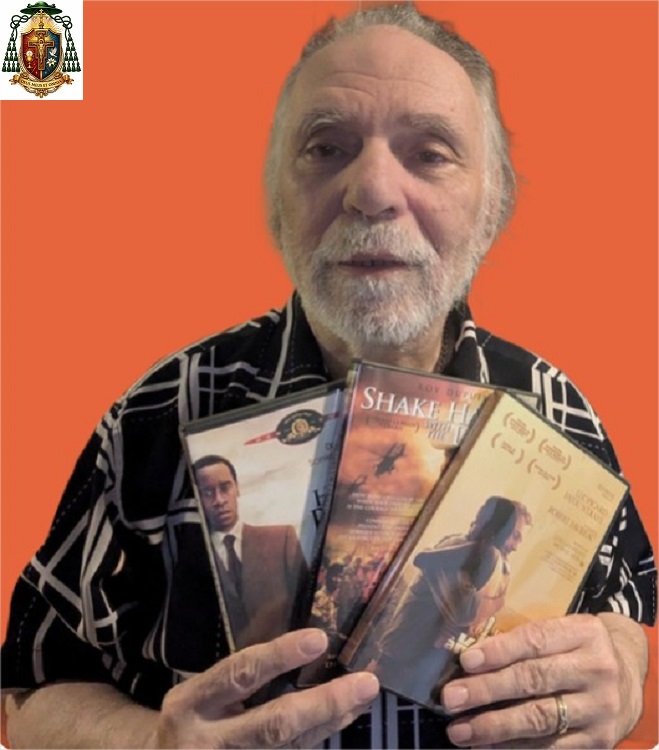
Hotel Rwanda is a 2004 biographical historical drama film co-written and directed by Terry George. It was adapted from a screenplay by George and Keir Pearson, and stars Don Cheadle and Sophie Okonedo as hotelier Paul Rusesabagina and his wife Tatiana. The film depicts Rusesabagina’s efforts to save the lives of his family and more than 1,500 other refugees by sheltering them in the besieged Hôtel des Mille Collines during the Rwandan genocide, which occurred during the spring of 1994. Hotel Rwanda explores genocide, political corruption, and the repercussions of violence. The film was critically acclaimed and on many of the year’s Top 10 lists. It was nominated for multiple awards, including Academy Awards for Best Actor (Cheadle), Best Supporting Actress (Okonkwo), and Best Original Screenplay.
Shake Hands with the Devil is a 2007 Canadian biographical war drama film starring Roy Dupuis as Roméo Dallaire, which premiered at the Toronto International Film Festival in August 2007. Based on Dallaire’s autobiographical book Shake Hands with the Devil: The Failure of Humanity in Rwanda, the film recounts Dallaire’s harrowing personal journey during the 1994 Rwandan genocide and how the United Nations did not heed Dallaire’s urgent pleas for further assistance to halt the massacre. The film received 12 nominations at the 28th Genie Awards, tying with Eastern Promises for the most nominations.
Un dimanche à Kigali. A Sunday in Kigali (original French title: Un dimanche à Kigali) is a 2006 Canadian feature film set during the Rwandan genocide. It is directed by Robert Favreau and based on the novel A Sunday at the Pool in Kigali by Gil Courtemanche.
The Rwandan genocide, also known as the Tutsi genocide, occurred from 7 April to 19 July 1994 during the Rwandan Civil War. Over a span of around 100 days, members of the Tutsi ethnic group, as well as some moderate Hutu and Twa, were systematically killed by Hutu militias. While the Rwandan Constitution states that over 1 million people were killed, most scholarly estimates suggest between 500,000 and 662,000 Tutsi died. The genocide was marked by extreme violence, with victims often murdered by neighbours, and widespread sexual violence, with between 250,000 and 500,000 cases of rape.
The genocide was rooted in long-standing ethnic tensions, most recently from the Rwandan Hutu Revolution from 1959 to 1962, which resulted in Rwandan Tutsi fleeing to Uganda due to the ethnic violence that had occurred. Hostilities were then exacerbated further due to the Rwandan Civil War, which began in 1990 when the Rwandan Patriotic Front (RPF), a predominantly Tutsi rebel group, invaded Rwanda from Uganda. The war reached a tentative peace with the Arusha Accords in 1993. However, the assassination of President Juvénal Habyarimana on 6 April 1994 ignited the genocide, as Hutu extremists used the power vacuum to target Tutsi and moderate Hutu leaders.
Despite the scale of the atrocities, the international community failed to intervene to stop the killings. The RPF resumed military operations in response to the genocide, eventually defeating the government forces and ending the genocide by capturing all government-controlled territory. This led to the flight of the génocidaires and many Hutu refugees into Zaire (now the Democratic Republic of the Congo), contributing to regional instability and triggering the First Congo War in 1996.
The legacy of the genocide remains significant in Rwanda. The country has instituted public holidays to commemorate the event and passed laws criminalizing “genocide ideology” and “divisionism”.
Mykola Swarnyk
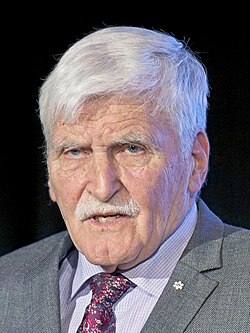
General Roméo Dallaire
Roméo Antonius Dallaire was born in Denekamp, Netherlands, to Staff-Sergeant Roméo Louis Dallaire, a Canadian non-commissioned officer, and Catherine Vermeassen, a Dutch nurse. Dallaire came to Canada with his mother as a six-month-old baby on the Empire Brent, landing in Halifax on December 13, 1946. He spent his childhood in Montreal.
He enrolled in the Canadian Army in 1963, as a cadet at the Royal Military College Saint-Jean. In 1970, he graduated from the Royal Military College of Canada with a Bachelor of Science degree and was commissioned into The Royal Regiment of Canadian Artillery.
Dallaire has also attended the Canadian Land Force Command and Staff College, the United States Marine Corps Command and Staff College in Quantico, VA, and the British Higher Command and Staff Course.
He commanded the 5e Régiment d’artillerie légère du Canada. On July 3, 1989, he was promoted to the rank of brigadier-general. He then commanded the 5th Canadian Mechanized Brigade Group. He was also the commandant of Collège militaire royal de Saint-Jean from 1990 to 1993.
Rwanda Original mission In late 1993, Dallaire received his commission as the Force Commander of UNAMIR, the United Nations Assistance Mission for Rwanda. Rwanda was in the middle of a civil war between the extremist Hutu government and a small Tutsi rebel faction. UNAMIR’s goal was to assist in implementing the Arusha Accords. The Hutus worked through the Rwandan army and the then-president of Rwanda, Juvénal Habyarimana. In contrast, the Tutsis worked through the rebel commander Paul Kagame, who is Rwanda’s president today. When Dallaire arrived in Rwanda, his mandate was to supervise the implementation of the Accords during a transitional period in which Tutsis were supposed to be given positions of power within the Hutu government.
Following the withdrawal of Belgian forces, whom Dallaire considered his best-trained and best-equipped, he consolidated his contingent of Pakistani, Canadian, Ghanaian, Tunisian, and Bangladeshi soldiers in urban areas and focused on establishing “safe control” zones in and around Kigali. Most of Dallaire’s efforts were devoted to defending specific areas where he knew Tutsis were hiding. Dallaire’s staff, including the UN’s unarmed observers, often relied on their UN credentials to save Tutsis, heading off Interahamwe attacks even while being outnumbered and outgunned. Dallaire and his staff are credited with saving the lives of 32,000 people.
Dallaire gave the major contributors to the force different evaluations for their work. In his book Shake Hands with the Devil, he gave the Tunisian and Ghanaian contingents high praise for their valiant and competent work. Ghana lost three peacekeepers. On the other hand, he criticized the Bangladeshi contingent for being poorly trained and poorly equipped. He was especially critical of the Bangladeshi contingent’s leadership for their incompetence and lack of loyalty to the mission and the UN chain of command.
As the massacre progressed and press accounts of the genocide grew, the UN Security Council backtracked on its position and voted to establish UNAMIR II, with a strength of 5,500 peacekeepers.
As revealed through testimony at the International Criminal Tribunal for Rwanda, the genocide was brutally efficient, lasting for a total of 100 days and leading to the murder of between 800,000 and 1,171,000 Tutsi, Hutu moderates and Twa. Over two million people were displaced internally or in neighbouring countries.
5 Canadian Mechanized Brigade Group
The 5 Canadian Mechanized Brigade Group (French: 5e Groupe-brigade mécanisé du Canada) (5 CMBG) is a Canadian Forces brigade group that is part of 2nd Canadian Division of the Canadian Army. It is based at CFB Valcartier, near Quebec City, Quebec. The brigade group is the formation responsible for the majority of francophone units of the regular army
5 CMBG Headquarters & Signal Squadron
12e Régiment blindé du Canada (Me, nope. The establishment of 5 Combat Group was tied to the creation of the new units under its control and between 1977 and 1992) I left the force in 1973, so 4 years before the brigade was formed.
5e Régiment d’artillerie légère du Canada
5 Combat Engineer Regiment
1st Battalion, Royal 22e Régiment
2nd Battalion, Royal 22e Régiment
3rd Battalion, Royal 22e Régiment
5 Service Battalion
I lived 7 min (2.3 km) from his house (1951 to 1977)
I serve in the 12 RBC with my unit, Hull Regiment (Reserve).
How close I was with a General: While living in Trois-Rivières, General Allard’s daughter and her husband gave us rides home (Marie and me) from the Legion.